
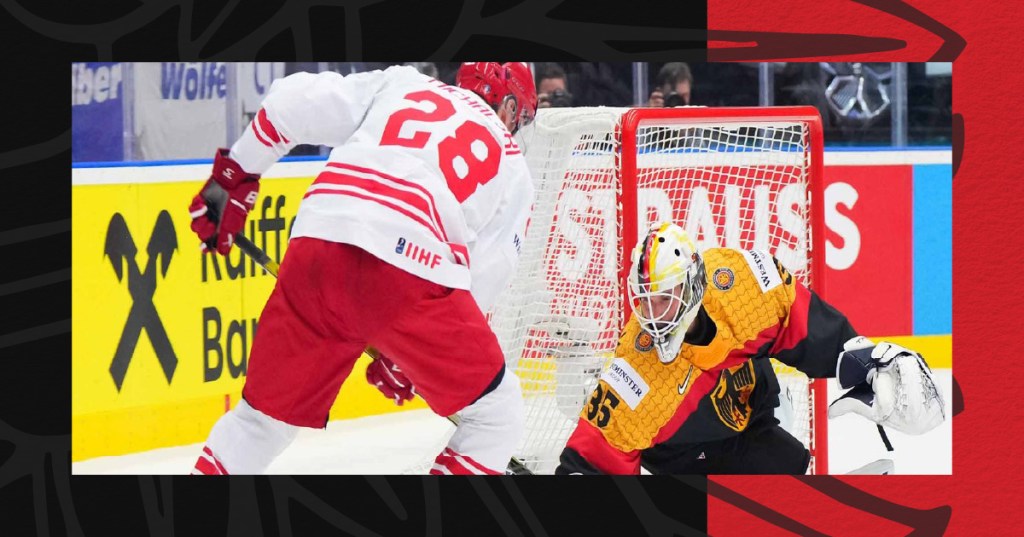
Heading into the 2026 Winter Olympics, I think the team I was most excited to see was Germany. While it helps that Gdansk’s Wojciech Stachowiak was on the squad, I was intrigued by the rare mix of talent. With Leon Draisaitl and Tim Stützle, Germany had two players in the top 25 of NHL scoring.
There are only two other times that a country outside the NHL’s big six populations (Canada, Czechia, Finland, Russia, Sweden, & United States) has had two top 25 scorers since 2005:
- Germany – 2023 (Draisaitl & Stützle)
- Switzerland – 2022 (Josi & Fiala)
When you look outside those top two talents, you have a top pairing defenseman in Moritz Seider, an NHL starting goalie in Philipp Grubauer, and five other forwards under NHL contract. Add in a growing domestic league, and Germany was among the popular underdog picks.
Germany’s Best Shot?
After taking silver in the 2018 Olympics and the 2023 World Championship, the 2026 best-on-best games seemed like a chance for Germany to really establish itself among the top hockey countries.
Instead, I think most people would argue that Germany had an underwhelming tournament. They would beat Denmark 3-1 before losing to Latvia 4-3 and the United States 5-1 in the group stage. They beat a struggling France team 5-1 to begin the elimination stage. This set up a quarterfinals matchup with Slovakia.
That Slovakia game is what really leaves Germany feeling like a failure. Slovak hockey has been in a pretty public decline. Legendary goaltender Jaroslav Halák, with tears in his eyes, once remarked that no one was coming and the death of Slovakian hockey was near. Germany, on the other hand, had all those recent medals and was fast catching Slovakia in terms of NHL players. If you just take a very simple approach, this year Slovakia’s eight NHL skaters had 120 points in 282 games. Germany’s seven NHL skaters had 233 points in 286 games (excluding Leon Draisaitl, it’s 153 points in 231 games).
All this to say it should have been a close match-up. Instead, Slovakia rolled past Germany, 6-2. For Slovakia, this win showed it was not yet doomed, as the Slovaks reached the bronze medal match, where they lost to Finland. For Germany, it may have been their best shot wasted.
Of the 17 German players drafted from 2010 to 2020, 8 of them appeared in 175 NHL games or more (Lukas Reichel has the fewest at 188 Games Played). That is an insane success rate for NHL draft picks at 47.1%. During that same time, the average NHL success rate for 175 games played was only 24.6%. Germany’s insane rate was aided by five being first-round picks.
In the five drafts since 2020, 12 German players have been drafted, but only one has played a single NHL game. The highest pick was Julian Lutz, 43rd overall in the 2nd round. While it’s way too early to judge those draft classes, nine of the picks are in the fourth round or later and don’t project to be top-end players. Germany currently has only one player receiving a draft ranking for 2026, with Darian Rolsing coming in at #158 among North American players by NHL Central Scouting. Max Calce will be one to watch for the 2027 draft.
While Germany continues to build a solid team, the question remains how long it will take them to develop another dynamic forward like Leon Draisaitl. Draisaitl will be 34 by the next Olympic cycle and likely starting to decline. Germany is just one of three countries (Slovakia – 7, Slovenia – 1) outside the NHL’s big six to have a top-10 scorer ever.
Having Draisaitl in his prime and a very strong supporting cast is going to be extremely hard to replicate. Hockey should hopefully continue to grow more popular in Germany, but in the relatively near future of Olympic tournaments, this was likely Germany’s best shot.
When Could Poland Match Germany?
Germany’s roster at this tournament made me question how long it would take Poland to reach their level. Could that talent level and an appearance in the Olympics happen during my lifetime?
The two countries share a border; they’re both in the top 10 of European population (Germany is over double Poland at 84 million), and both are in the top 10 of European GDP. Hockey is not the dominant sport in either country, but it’s definitely higher up the list in Germany.
According to the latest IIHF report, Germany has 6,797 senior male players and 16,552 youth players (U8-U20). Poland only has 458 senior players and 3,049 youth players. When it comes to rinks, Germany has 143 total indoor rinks and 76 outdoor rinks. Poland has only 26 indoor rinks and 10 outdoor rinks.
The German league system is so much larger than Poland’s. Across their top three senior leagues, which all feature professional players, there are 53 teams with over 800 German players. Poland, on the other hand, has nine professional teams in its lone professional league, which features 153 Polish players.
Simply put, Poland has never had the level of hockey infrastructure investment that Germany has. From the number of rinks built to the quality of the teams they built. Not only were investments made in arenas, but also in the teams and staff. By having strong teams, they could attract quality players and staff from North America and Europe. This also allowed them to bring in players like John Tripp, Len Soccio, and Martin Reichel as imports, who could boost the national team and keep them in the top division when needed. With the combined development of rinks and the growth of domestic leagues, Germany became a constant producer of talent.
In Poland, there is some progress on ice rinks. A large investment project is just moving past the bid phase, while other major arenas are undergoing renovations. Announced so far are a new year-round rink in Tychy, a modernization of the rink in Cieszyn, and a new sheet of ice coming in Ruda Śląska. This is on top of already announced and/or ongoing upgrades in Krakow, Jastrezbie, Oswiecim, and Warsaw.
“This is a truly impressive project, now in its second year. Thanks to it, nearly 100 ice rinks will be built and renovated across Poland. The Ministry of Sport and Tourism has allocated 200 million (PLN) for these investments. Poland has never had a program like this dedicated to ice rink infrastructure,.” – Minister of Sport and Tourism Jakub Rutnicki.
How many of these projects will fully go ahead will be interesting to watch. But for Poland, the potential exists to follow Germany’s footsteps. 2010 is appearing to be Poland’s best class of young players in a long time. The 2011 class is already highlighted by star prospect Gabriel Wsol. While Aleksander Ptasinski is the current highlight among the 2012 class. The U18 squad will play in Division 1 Group A for the first time in history. There looks to be a lot better youth talent coming than what Poland had in the 2010s.
But when it comes to qualifying for the Olympics and having a roster close to Germany, these projects are just the start of the long journey. Don’t expect Poland competing at France in 2030, the USA in 2034, or Switzerland in 2038. This generation that could be coming for Poland would be the one that lays the groundwork as kids take their first skates on the new rinks. Before Germany had Draisaitl, Grubauer, Seider, and Stützle, they had Christian Ehrhoff, Jochen Hecht, Marco Sturm, Olaf Kölzig, and so many others. When you’re constantly producing NHL draft picks at a decent pace, you’re eventually going to hit some diamonds. Poland is still looking for its first national team member drafted since 2003.
If everything goes perfectly for Poland, the earliest I can see a solid Olympic appearance is in 2042 or 2046. But things are rarely ever perfect, and it also requires hitting big on plenty of draft picks at a better than average rate. A committed program with more rinks and support could realistically compete at the 2050 or 2054 games. Hopefully, the Polish Puck site is still active then.
If you want to keep up with all the Polish hockey action, make sure to follow us on Twitter @PolandHockey, like our Facebook page, and add us on Instagram @PolishPuck_. Also, support us on Patreon to help keep the content flowing!
Photo via IIHF.com
 Polish Puck
Leave a comment