
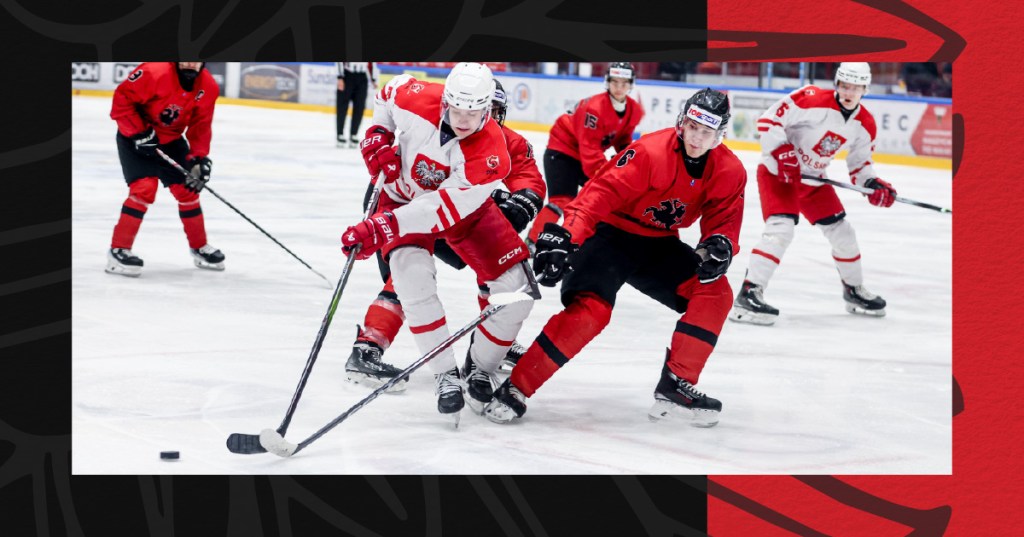
The World Juniors are the event where Poland has struggled the most in recent years. At all other levels of IIHF play, Poland has captured multiple medals in the past five years. The World Juniors haven’t seen the white and red finish higher than fourth since 2019. A lot changed in the offseason, from a revamped domestic junior league to a brand new coaching staff, which won back-to-back gold medals at the U18 level. Would the changes result in a new fortune for Poland?
Coming into the tournament, Poland looked to have a chance at promotion. The squad looked good, and it was maybe a year when usual strong rivals like Italy and Japan were not at their best. Those two familiar foes were also the first two opponents.
Poland kicked off game one in Milan against the host in Italy. While Italy may have scored first and quickly, less than two minutes into the game. Poland controlled this one early. They outshot Italy 15-2 in the first period and would climb to a 3-1 lead by the end of the second. The young Poles picked up a game one win, 4-2.
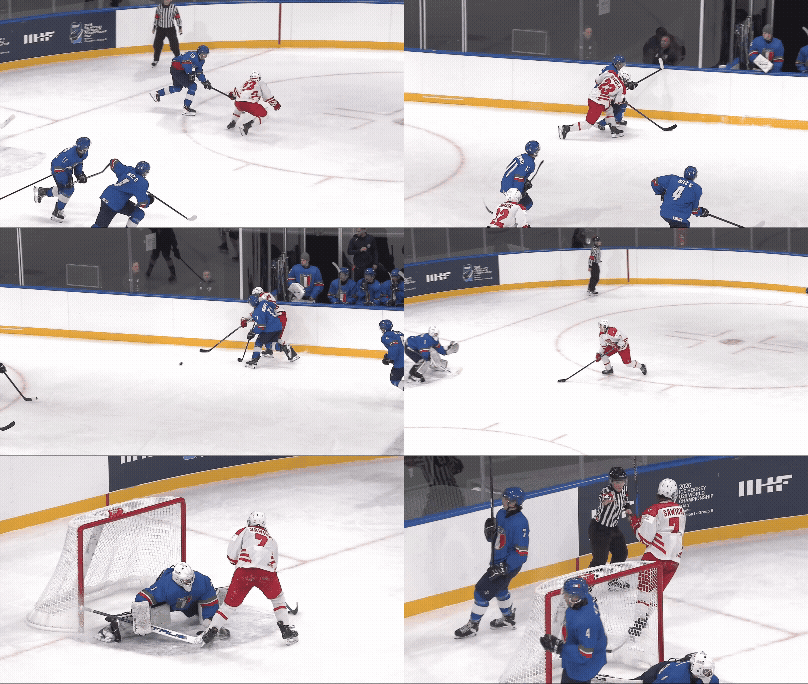
Game two would feature a Japan team facing tons of change. Only a few returning players from last year. Another hot start saw Poland control play and the score, leading 2-0 after two periods. The white and red parked the bus pretty hard in the third, they were outshot 13-3, but Igor Tyczyński closed the door. With a 2-1 final, it was Poland U20’s first win over Japan since 2018.
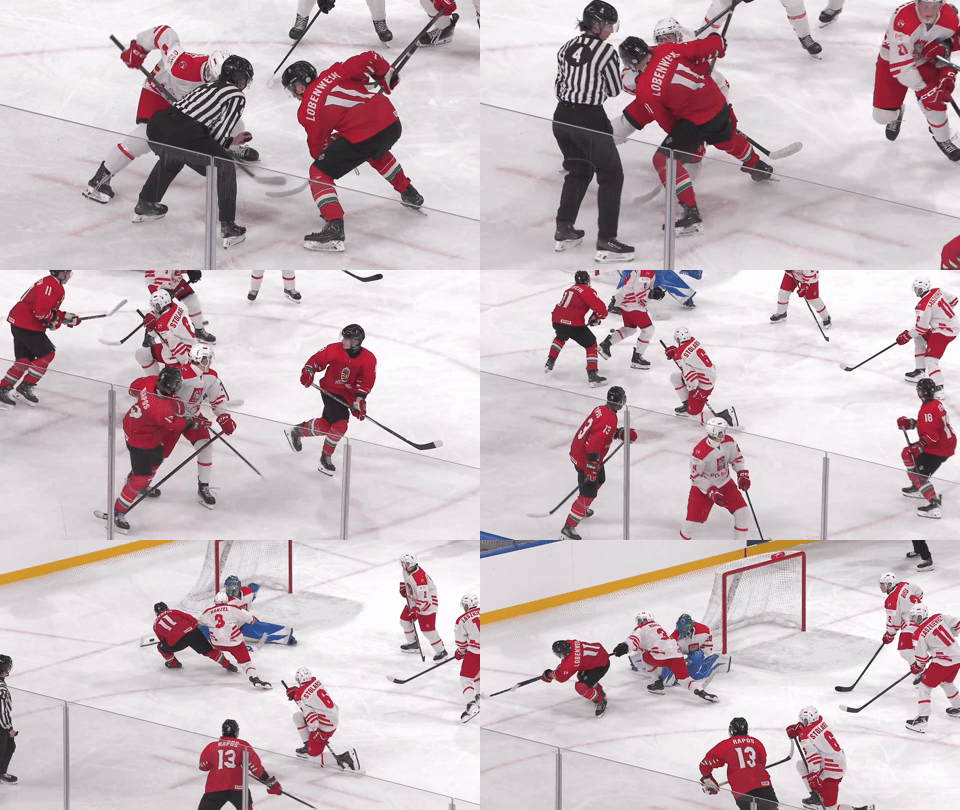
Game three now all of the sudden had huge stakes. Poland was matched up against the heavy group favorite, Hungary. The winner of this game was likely to be the gold-medal winner. This game was as tight as they come. There were three lead changes, and not a single one of those leads lasted more than three minutes. As soon as one team scored, the other answered just as quickly. This game went to overtime, where Hungary completely controlled the puck and just had to wait for a Polish mistake. The overtime final was a 4-3 win for Hungary.
That overtime loss might have been a turning point for Poland, which saw its chances of gold slip away. Game four was a chance for a few returning players to right a wrong from last season. Last year, Estonia made a late comeback against Poland to pull off an “upset”. Unfortunately, the 2025 edition of this game was no better as Poland blew a late lead before losing in overtime 5-4. Estonia was the youngest team in the tournament, the only one with an average age under 18. Poland was the second oldest. Two years in a row of blowing late leads to Estonia is a rough outcome.
After two heart breaking losses in a row, Poland faced a Lithuanian team that still had a chance at gold. The emotions might have been too much for the young squad to overcome, as they looked a bit defeated and Lithuania completely shut down the their offense. With only 15 shots on goal, the white and red lost their final game 1-0. A Polish team that was only one goal away from potential gold at the halfway point ended up in fourth.
Neutral Zone Woes
In a far-from-perfect tournament for Poland, the biggest issue I saw was in the neutral zone. The young players struggled in the area with poor break-ins and sloppy miscues that led to unforced or too-easy turnovers. There were quite a few timing issues with drop passes that turned into potential odd-man rushes into offside whistles. Especially when playing as the underdog, like against Hungary, those rushes and moves through the middle of the ice matter so much. Hungary did a great job of preventing Poland from attacking the middle of the offensive zone. That is where it would have been nice to be more successful in those rushes and that starts in the neutral zone.
Tyczyński on Top
Igor Tyczyński proved why he has a chance to be the future of Poland in goal at this tournament. The Unia Oświęcim netminder was named the best goalie of the group after finishing with a .930 SV% in three games. It was an outstanding performance by the young goalie, who showed great poise, especially when Hungary was constantly creating chances in dangerous areas. His strong performances raise the question of why Gusov started Tobiasz Jaworski against Italy and Estonia. Jaworski looked good against Italy, but struggled against Estonia. I can understand not wanting to play a goalie back-to-back days, but sometimes you have to ride your elite starter at these events.
Lacking a Star
Coming into this tournament, I noted Poland did not have a star on its roster. There is no doubt that some players on this team have the potential to play in strong leagues outside Poland. But there wasn’t a player I saw who was at a level where they could guarantee you a point or two a game. While which league a player plays in isn’t everything, it’s a pretty quick indicator of talent. When you look at Poland’s opponents, you see a lot of players from strong leagues.
Estonia: David Timofejev (U20 SM-sarja), Maxim Burkov (Maxa Liga)
Hungary: Döme Szongoth (BCHL), Domán Kristóf Szongoth (U20 SM-sarja), Bendeguz Ven (U20 Nationell), Ferenc Laskawy (ICEHL).
Italy: Jacopo De Luca (QMJHL), Rocco Meneghetti (U20 Nationell)
Japan: Daigo Hotta (NAHL)
Lithuania: Danielius Cecekovas (U21-Elit), Dovydas Jukna (QMJHL), Mykolas Skadauskas (WHL)
When Poland was in overtime against Hungary and Estonia, it was three-on-three, the ice was wide open, and those star players were able to play keepaway from Poland and score when their team needed it most. This is not to put any player down. Poland needed a player of star pedigree to win gold at this level and didn’t have it this year.
Gusov is the Guy
While Gusov was not able to make it three straight gold medals and promotions for Poland, this was a step in the right direction for the Polish U20 team. The team looked better overall. With 8 points, it is the best finish the U20 squad has had since 2019. Every loss was by a single goal, with two being in overtime. Gusov and his staff did a great job getting the group to play good, defensive, responsible hockey. At only 13 goals allowed, it’s the lowest amount permitted by Poland since 2016. Poland took the least amount of penalties in the entire tournament and only allowed a single power-play goal against in ten penalty kills.
There is some work to do offensively, as Poland finished with the fewest shots in the tournament. That shot number was heavily hit by the final game. Poland has to find a way to score more and really bury some of these early games. Outside of just scoring to win more games, these are tight groups, and goal differential could come into play.
What’s Next?
It’s the question we always ask at the end: what is next? For Poland, there is a lot to be optimistic about. Only eight players will age off this roster, but solid replacements are ready to go. They’re losing big names in Bartlomiej Stolarski, Igor Tyczynski, Jakub Onak, Oskar Laszkiewicz, Patryk Hanzel, Rafal Drabik, and Wiktor Bieda. Some of the early options from the 07’ and 08’ classes.
2007: Michal Cybulski (F), Wiktor Zajac (F),
2008: Borys Dawid (F), Kacper Skiba (D), Leon Stryczek (F), Jan Matera (D), Radoslaw Kot (F), & Wiktor Tanczyk (D)
2009 marks the start of really talented classes in Poland; one of them could break through.
I think adjustments made to the league system for 2025-2026, new training standards being set by IIHF Hall of Famer Henryk Gruth, and the new staff have this junior program headed in the right direction. Next year, Poland will be joined in the group by recently demoted France, along with returners in Lithuania, Estonia, and Japan. We won’t know which team will earn promotion from Division 2 Group A until January 10th.
Quick Thoughts
- Szymon Guminski had an excellent tournament. He stood out at times at both ends of the ice.
- Polish fans remain some of the best in international hockey. The Poles led the tournament in attendance with a total of 4,364. Almost 1,000 more than second-place Japan.
- Not a Poland note, but Estonia went 17 for 17 on the penalty kill. That has to be some kind of record.
- Jakub Janik and Olaf Zachariasz were such a fun duo at this tournament. I was shocked they’ve never played together at the club level, given their insane chemistry.
- Adam Sawicki was another standout at this tournament, finishing with two goals. He is developing well in American junior hockey.
If you want to keep up with all the Polish hockey action, make sure to follow us on Twitter @PolandHockey, like our Facebook page, and add us on Instagram @PolishPuck_. Also, support us on Patreon to help keep the content flowing!
Thumbnail Photo via polskihokej.eu
 Polish Puck
Leave a comment