
As someone who grew up in North America, the World Juniors were the biggest international hockey event of the year. The top prospects tournament was only ever topped by the Olympics. In a decade of covering Polish hockey, the junior events have never mattered that much. The stakes are much lower at the Division One and Division Two levels. The events are not crawling with scouts looking for potential draft picks or future franchise pieces. The difference in attention from the top of the hockey world means it makes sense for players to choose another country over Poland if they have the option, the most recent example being Patryk Zubek going to Slovakia.
For the entirety of my time covering Polish hockey, there is a quote that always sticks with me. Sport.sk asked Damian Tyczynski about playing in the NHL or a top European league, and he responded, “Of course. It is my dream. But there is one problem – I am a Pole, and they do not want the Poles. When they learn that I am from Poland, they lose interest.”
Poland last played at the top level of the World Juniors in 1997. This past year, they returned to the top level of the World Championship for the first time since 2002. Polish hockey is no longer in the abyss of the international hockey world. They made a statement at the World Championships. They have made statements in the Champions Hockey League. The quality of imports to the Polska Hokej Liga (PHL) is much higher than a decade ago. People are again starting to pay attention to the sport in Poland. However, those in charge still neglect too many parts of the game. I never believed it when a Swedish coach said Polish hockey is mission impossible. The senior team proved that it was not an impossible task. Regarding Poland returning to the World Juniors, that is an impossible task.
Despite some losses and struggles at the U20 level, Poland’s future is bright, highlighted by major 2010 and 2011 classes. Those players are half a decade away from Poland U20. Many big names from those classes have already moved from Poland to strong youth leagues in Czechia, Finland, Sweden, and Switzerland, which also means their chances of being poached away from Poland grow.
There are only two ways to protect your talent from this scenario, even if it’s relatively rare. You put them on the U18 squad to secure their IIHF rights immediately. The second is you make your U20 national team an attractive place to play. Poland U20 has only competed at the Division 1 Group A level once since it was established. They have been permanently stuck in Division 1 Group B hockey purgatory. But how does one get stuck there for 10 straight years without promotion or relegation?
There are a few factors that led to this. Some lift the team as to why they stay up in division one, while others drag the team down from ever reaching group A.
First, Polish U20 squads have lived and died with their star players. Those stars mostly play outside Poland in major North American or European junior leagues. Occasionally, there have been Polish stars trained at home, but they’re never the leading force. Since 2012, when the Group A and Group B format started, there have been 12 Division 1 Group B tournaments. Polish players have led the tournament in points six times.
| Year | Player | Country | Points | Team Result |
| 2023-2024 | Nikita Sidorenko | Ukraine | 12 | 2nd Place |
| 2022-2023 | Krzysztof Macias (F) | Poland | 10 | 4th Place |
| 2021-2022 | Tomas Simonsen | France | 15 | 1st Place. Promoted |
| 2019-2020 | Jakub Lewandowski | Poland | 13 | 4th Place |
| 2018-2019 | Jan Drozg | Slovenia | 12 | 1st Place. Promoted |
| 2017-2018 | Alan Lyszczarczyk | Poland | 15 | 2nd Place |
| 2016-2017 | Alan Lyszczarczyk | Poland | 11 | 2nd Place |
| 2015-2016 | Bastien Maïa | France | 11 | 1st Place. Promoted |
| 2014-2015 | Nikita Mikhailis | Kazakhstan | 11 | 1st Place. Promoted |
| 2013-2014 | Nikita Mikhailis | Kazakhstan | 11 | 2nd Place |
| 2012-2013 | Kacper Guzik | Poland | 11 | 1st Place. Promoted |
| 2011-2012 | Damian Kapica | Poland | 10 | 4th Place |
The team with the leading scorer has been promoted five times. If you remove the Polish leading scorers, the team with the top scorer was promoted or finished second every year. Poland managed three fourth-place finishes despite having the tournament’s best player. All of these players also did it while playing outside Poland for their club season, except Kacper Guzik. Guzik played in the United States from 2007 to 2012 with the Little Caesar youth program and the Michigan Warriors in the NAHL. He only returned to Poland to play professionally in 2013.
| Year | Player | Team (League) |
| 2022-2023 | Krzysztof Macias (F) | HC Vítkovice U20 (Czechia U20) |
| 2019-2020 | Jakub Lewandowski (F) | Sioux Falls Stampede (USHL) |
| 2017-2018 | Alan Lyszczarczyk (F) | Owen Sound Attack (OHL) |
| 2016-2017 | Alan Lyszczarczyk (F) | Sudbury Wolves (OHL) |
| 2012-2013 | Kacper Guzik (F) | GKS Tychy (PHL) |
| 2011-2012 | Damian Kapica (F) | HC Oceláři Třinec U20 (Czechia U20) |
Despite the odds, Poland has produced players who can play in the top junior leagues. The results are dreadful when Poland is without one of these players who can carry the team. Still, you look at other countries that roam D1A, D1B, and D2A, and you see years with NHL draft picks followed by years with no talent to speak of. For example, Italy was relegated in 2020 with a squad that produced zero players who play in major North American or European leagues. The 2023 bronze squad has an SHL goalie who was drafted into the NHL, a regular in the top Swiss league, and six players in the ICEHL. Poland hasn’t had these extreme peaks and valleys. However, none of Poland’s tournament-leading scorers played with each other on U20 squads. That lack of consistency led to the team lacking offense as soon as one of these stars aged off the U20 national team.

The occasional star who plays outside Poland has kept the U20 squad up in some groups while other years propels them to a medal. What has kept Poland up in those seasons without a star? It used to be the depth of the U20 program. While most of the team was not great, they were division one level junior players. It was rare for more than a couple of team members to look like they didn’t belong in the division.
Poland used to have a better system for young players. You had three stops for players with a u20 level (Centralna Liga Juniorow), a second level of senior hockey (Polska 1. Liga), and the best of the best young players would play in the Polska Hokej Liga with PZHL U23 (2019-2020) or SMS U20 Sosnowiec (2016-2018). PZHL U23 and SMS U20 Sosnoweic only played half of the PHL season. This allowed young players to return to lower levels to finish the year strong or join their home club for meaningful late-season PHL games. It was not a perfect or excellent system by any means. It needed a lot of work, but it allowed players to go at a better pace in their development while getting to play a lot of games.
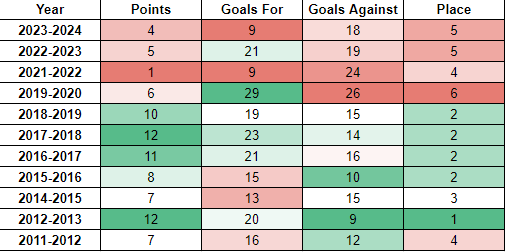
Starting in the 2020 season, the Polska 1. Liga would become the Mlodziezowa Hokej Liga (MHL). This league combined the second level of Polish hockey with a junior league. While the Centralna Liga Juniorow still exists, it is nothing more than a playoff tournament now. What was the effect on the junior team? All you need to do is look at the before and after. Since the MHL became the only place for U20 players, Poland U20 has bottomed out.
Teenagers need to play against teenagers their age. Playing a lot of games with opponents of a similar level is how you get better. Constantly playing low minutes or getting destroyed by older players is will not do anyone any good. Yes, the best of the best should play against strong senior teams if their skill is at that level and they’re ready to move on. But most Polish players in the 18-20 range are not. But right now, they’re either playing low minutes in the THL or they’re in the MHL, where the average team age ranges from 16.59 to 22.29. There are six players over 30 in the league. This current system does no one good. The average age of a top 20 scorer in the league is 21.25. What good does it serve for Poland to have some adults beating down weak teams full of teenagers? What good are junior players getting from playing weak senior teams or teams young by U18 league standards? This whole league is a mess, creating a dead zone for development. The coaching is not up to the needed level, and the quality of the sport isn’t. You’re just providing a place for 80% of your junior players to waste away until they retire in their early 20s.
Poland went from a country just barely away from the U20 Division 1 Group A with four straight silver medals to one just hoping to stay in up in Group B. They should have been relegated multiple times but got lucky with upset wins, a global pandemic, or a war in Ukraine keeping them up. World circumstances gave Poland a second chance at life in Division One, and they did nothing with it. Poland U20 used to be a team where, with just a little bit better depth, Poland would have been promoted. Now, without a star prospect, Poland is dead in the water, just waiting to be pulled down to Division Two.
Over the past 10 events, I have seen Poland struggle with the fundamentals due to poor coaching and a lack of structure. Often, imports who play in Poland describe the chaos of Polish players and how there is no set Polish style since so many players are self-taught or have had such different approaches to training. The U20 team emphasizes chaos more than anywhere else, as players who play their whole lives together suddenly have no chemistry. No one seems to trust their teammates, which leads to them trying to cover for each other and only creating more lapsed coverages and mistakes. Junior players in Poland lack the fine minor details to their game. Those little things are so important, and you have to do then shift after shift. When Poland goes against the junior squads of France, Italy, Hungary, or Japan, those countries do all the small things right. When it comes to the most important games, they’re not trying to overcome a mountain of mistakes. They’re just trying to play their brand of hockey.
When I look at Poland’s last ten tournaments, I see the same things repeatedly. A top-heavy team whose stars most likely played abroad just found a way to lose in the end. Poland U20 choked away a few considerable chances to win gold and promotion before descending into the program’s modern-day mess.
- 2013: Poland won gold and was promoted to D1A. Kacper Guzik and Filip Starzynski, who played youth and junior hockey in the United States, led the team in scoring. Adam Domogala, who played in the German junior system, was third in scoring. However, some credit goes to David Zabolotny, who played in the SMS Sosnowiec program and came up big in net.
- 2014: Poland finished sixth and was relegated. The U20 team only scored six goals in five games in D1A, despite strong performances from Polish-trained Patryk Wronka and Bartosz Fraszko. The team had no players in major European or NA junior leagues.
- 2015: Poland wins bronze in D1B. Polish-Canadian goalie Michael Luba was the only player on the roster who played outside Poland. He started for HK SKP Poprad U20 in Slovakia and won the tournament’s best goalie award. Wronka was involved in seven of Poland’s 13 goals.
- 2016: Poland wins silver in D1B. Kamil Sikora, who came up in the Czech junior system, leads the team in scoring with six points. There are two players not to play in Poland. The red and white scored nine of their 15 goals in one game against the UK. To win gold on the final day, Poland only had to avoid losing to France by five goals. They lost 7-2.
- 2017: Poland wins silver in D1B. Top prospect Alan Łyszczarczyk leads the team in scoring with 11 points. After playing in the Czech junior system, Łyszczarczyk moved to the Ontario Hockey League in Canada. He forms a great pairing at the event with Polish-trained Bartlomiej Jeziorski. On defense, Poland is led by Yevgeni Kamenev, who plays in Slovakia, and Tomasz Skokan, who plays in the lower levels of US junior hockey. Poland again lets promotion slip away with a brutal loss to Italy on the tournament’s final day. Italy was facing possible relegation.
- 2018: Poland wins silver in D1B. Alan Łyszczarczyk is still in the OHL. Dominik Pas has been added to the top line with Jeziorski and Łyszczarczyk, and they are the best line in the tournament. Only defenseman Grzegorz Radzienciak (Czechia U20) and Pawel Oblonski (2nd level of Swedish U20) also play outside Poland. Canadian David Leger coaches the team. This was Poland’s best chance to win gold and promotion. Unfortunately, they ran into Norway U20, a surprise relegation from D1A the previous year. Norway beats Poland in a shootout to capture gold. Norway played in the Elite Division at the 2024 World Juniors and hasn’t finished worse than fourth in D1A since 2018.
- 2019: Poland wins silver in D1B. Dominik Pas, Kamil Walega, and Jan Soltys form the new top line, all coming from the JKH GKS Jastrzebie junior system in Poland. In addition, Łukasz Kamiński, Olaf Bizacki, Sebastian Brynkus, and Pawel Zygmunt are all trained in Poland as well. It was the most substantial group of Polish-trained players during this time—only 17-year-old defenseman Szymon Bieniek played in a major European junior league. Poland would lose twice, including a game where Poland took an unnecessary penalty in overtime, where eventual gold winner Slovenia would score a powerplay goal to win.
- 2020: Poland finishes fourth in D1B. One of the weirdest tournaments I have ever watched. Poland was led by top prospect Jakub Lewandowski, who came up in Czechia and now played in the United States’ top junior league. Poland scored 29 goals in this tournament, tied for first. They also allowed 26 goals against, the second most. Poland beat Italy 15-3, but also lost 7-1 to France, 3-0 to Ukraine, and 10-7 to Hungary. Goaltending and defense doomed Poland at this tournament, while the average of 8 goals per game made it hard to judge anyone or team offensively. Poland finished with 75 penalty minutes, 25 per game, and had their worst finish of the century.
- 2021: The Tournament was canceled due to the COVID-19 pandemic
- 2022: Poland finishes last place and is relegated. Their relegation would be canceled due to the suspension of Russia and Belarus for the war in Ukraine. Poland never once looked like a Division 1 Group B team at all. Polish coach Artur Slusarczyk and his staff put the squad in zero positions to win. In a crucial match against Estonia, Poland gave Estonia a quarter of the game in powerplay time. Estonia won 4-3 in overtime despite only having 12 shots. 17-year-old Krzysztof Macias and Jakub Slusarczyk were the only players who played in a major junior league outside Poland.
- 2023: Poland finishes fourth place in D1B. The top five players in scoring on Poland at this tournament played in Czechia or Slovakia. Poland would finish just outside the medal range but avoided a last-place finish like last year. They found a way to beat the teams they were supposed to, including a blowout of South Korea 11-2.
- 2024: Poland finishes fifth palace in D1B. I don’t think there is anything lower for the U20 program than losing to Croatia while blowing a two-goal lead. I still have no idea how Poland beat Italy on the final day to avoid relegation. A team Italy with multiple borderline NHL draft picks, while most of the remaining roster played in the Swiss junior system. Poland scored nine goals in this tournament; four were against Croatia, and four were against Italy. Michal Kusak (Czehia U20) led the way with two goals and two assists. This team never played 60 minutes of good hockey in any game.
The results speak for themselves. Poland junior hockey is drowning, and I don’t want to see talented future classes go down with it. Polish junior hockey must reestablish a more substantial format for junior players. This is no longer a problem for the performance at some junior IIHF events. You already have two teams mainly using only junior players in the PHL. There are rumors that more teams might have to rely on young players more. The PZHL president is very open about Tauron and other sponsors ending early, putting the league in a dangerous spot. If those budgets fall, Poland lacks developed young players who can play at a high level to fill the league. The MHL is not creating players who are good at a professional level. That is why many of the MHL’s leading scorers can never escape it. When more clubs have to play those former MHL players, the league quality will fall, and teams will die. The best Polish players will decline, and the national team will fall.
If you want to keep up with all the Polish hockey action, make sure to follow us on Twitter @PolandHockey, like our Facebook page, and add us on Instagram @PolishPuck_. Also, support us on Patreon to help keep the content flowing
Thumbnail Photo via polskihokej.eu

 Polish Puck
Leave a comment